What Are Your Points of Reference in the World of Contemporary Jewelry and Art

How adept is contemporary jewelry at negotiating a earth in flux? Making the about of flux requires fluidity, an ability to embrace movement and change with ease and grace. The contrary of fluidity is fixity, a quality that, in the globalized globe contemporary jewelry now inhabits, represents a stubborn clinging to place, a refusal of the possibility of belonging everywhere and thus nowhere specifically. In a time when fluidity is prized, what value can a commitment to fixity take for contemporary jewelry practice?
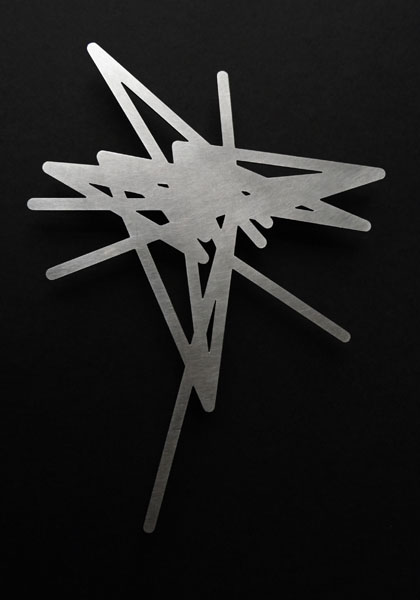
Searching effectually for contempo jewelry that might correspond flux, I came across Otto Künzli's Himmel brooches, which are based on maps of airline routes. The German language word Himmel means both sky and heaven, so it is at once a physical and metaphysical location. As Künzli puts information technology, 'In our Himmel yous can find shipping and clouds and skyscrapers but also angels and dreams and ancestors.' (Künzli 2011) And this, which also seems important: 'Although my brooches are based on the maps of airlines information technology is afterward all not important to recognise particular routes and I do not support any speculation in that direction . . . Instead I wish and hope that my brooches evoke imaginative journeys to fantastic, wonderful, inner and outer places and realms.' (Künzli 2011)
Künzli's brooches celebrate new constellations generated by a condition of being incessantly on the move, in transit. These brooches are literally nowhere, floating outside of identify. They are a perfect sign for the globalized, freewheeling, de-territorialized jewelry practise which, I think, is contemporary jewelry'southward most celebrated response to a earth in flux.
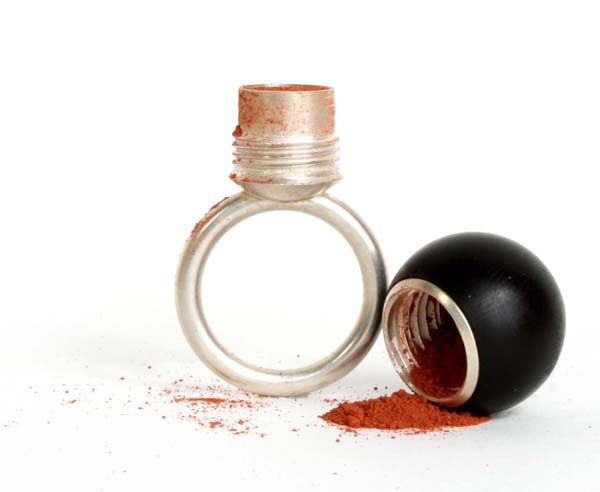
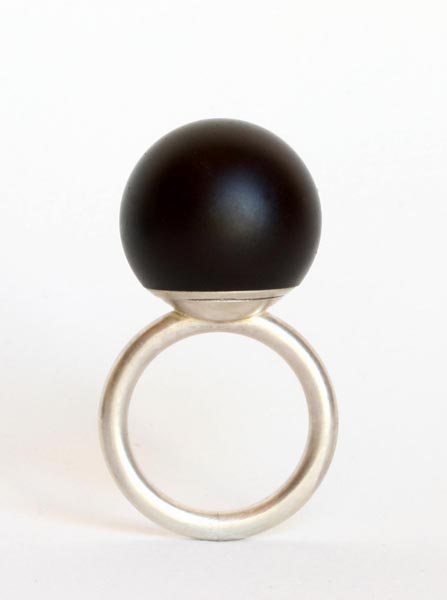
Like a geologist taking a core sample, the wearer/owner of the band literally digs their jewelry into the ground to gather a slice of the earth from the place that matters well-nigh to them. World Band belongs to the same modernistic world of mobility as the Himmel brooches, since it assumes the wearer will be in transit and thus need to accept a relic of home with them. However it doesn't revel in a country of nowhere-ness and it seeks solutions for remaining connected to place in spite of all the move. If Künzli specifically asks that we pass up region or place when because his brooches, Freeman makes place and region – through soil, the very world itself – critical to the meanings of his band. Here, fixity stands in contrast to flux.

Stories of Art (Jewelry)
So let me exist a little controversial and advise some other manner to articulate the difference between these two jewelers. Otto Künzli is a Swiss contemporary jeweler living in Munich who makes contemporary jewelry. Warwick Freeman is a New Zealand contemporary jeweler living in Auckland who makes New Zealand gimmicky jewelry. Künzli, in other words, doesn't need a qualifier to define and locate the kind of jewelry he makes, whereas Freeman does. Saying this is to say that the global, freewheeling, de-territorialized jewelry practice has come to seem universal, while the local or regional jewelry practice has come up to seem the opposite.
The standard story of art is the story of 'how western fine art progressed from archaic symbols to highly naturalistic styles, and then how modern artists turned away from naturalism and became skeptical of the world of appearances.' (Elkins 58-59) Information technology runs basically like this: 1) Arab republic of egypt and Greece, where human proportions were studied mathematically; two) the near-loss of that knowledge in the Night Ages; 3) the rediscovery of classical knowledge in the Renaissance; 4) the elaborations of baroque and rococo; 5) art turning confronting its naturalistic heritage with modernism. Because western art is unique in its pursuit of naturalism, or at least the vigor with which it pursues this goal, naturalism becomes the story of western art. And because the sequences of western art history shape all fine art history, all art production is compared with the standard story, no thing how inappropriate this might be.
Does art history also propose a dominant narrative for the history of gimmicky jewelry? After comparing as many historical accounts of contemporary jewelry as I could get my hands on, I would say the answer is yes. What I identify as the standard story of contemporary jewelry is best captured in Peter Dormer and Ralph Turner'south book The New Jewelry: Trends + Traditions, published in 1985. Allow me briefly show you lot how the story unfolds.
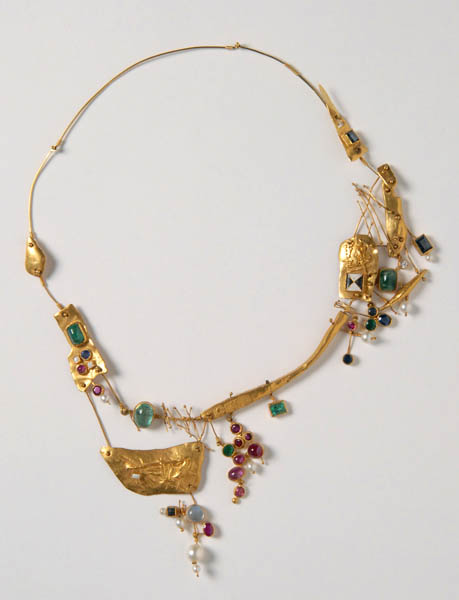
Dormer and Turner and so motility to the Netherlands and the jewelers Gijs Bakker and Emmy van Leersum, who not merely innovate new materials such as aluminum but also connect contemporary jewelry to its cultural moment and encourage it to get more democratic. The story stays in the Netherlands with B.O.E., a revolutionary motion reacting against the 'dominant clinical approach' of the Dutch Shine mode.
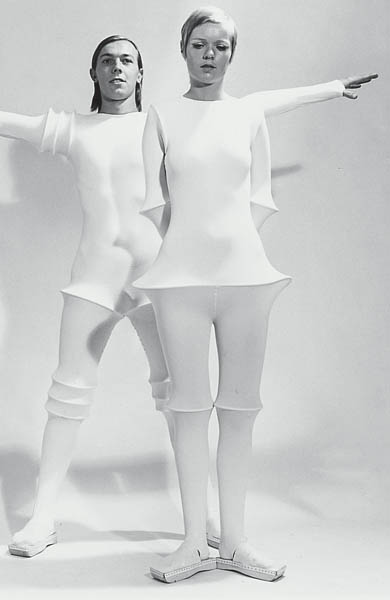
Then comes United kingdom, as a upshot of the stimulating exchange that developed between Dutch and British jewelers in the tardily 1970s. The major claim to fame here is the movement towards 'wearables' in the work of people like Susanna Heron and Caroline Broadhead.
At this betoken, the authors can define the new jewelry as a movement emerging from Federal republic of germany, the Netherlands, Britain, Austria and Switzerland. It is characterized past 'a desire to avoid clichés in blueprint; a desire to make heady, robust and, where possible, cheap ornament; a desire to brand adornment that can exist worn by either sexual practice; a frequently expressed distaste for jewelry which is vulgar and merely status-seeking; and always an interest in ensuring that the decoration works with and complements the wearer's trunk.' (Dormer and Turner xiv)
Now Dormer and Turner introduce gimmicky jewelry from America, making clear that it embodies some significant differences from what's happening in Europe. 'In the United States,' they write, 'the electric current trend is to regard jewelry equally mini-sculpture rather than wearable ornament which has to be worn in order to exist seen properly.' (Dormer and Turner fourteen)
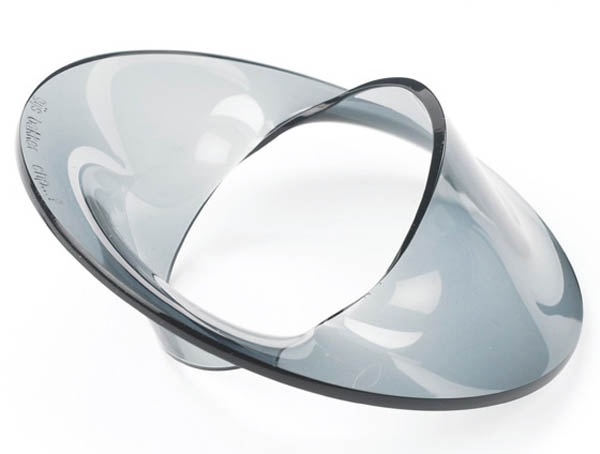
Dormer and Turner's historical narrative concludes with Italian jewelry, which fits nicely at the end. Important Italian jewelers accept also been sculptors, which connects neatly to the jewelry versus art event that is key to American work. Italian jewelry is very distinctive, similar America, but links to European minimalism – even if information technology isn't quite as radical as what'due south happening in other parts of Europe.
This narrative is contemporary jewelry's standard story, its equivalent to the struggle towards naturalism in western art. The core of the story is not a search for realism, but the critique of preciousness and the struggle to liberate jewelry from restrictive notions of value, so that it becomes available for artistic expression and experimentation, a deeper engagement with order, and a new awareness of the trunk and the wearer. Schematically it appears like this: 1) Frg, with traditional goldsmiths introducing artistic expression into their piece of work; 2) kingdom of the netherlands, with the socially and materially radical experiments of Dutch Smooth; 3) New Jewelry emerging through the fusion of Dutch and British jewelers; 4) American and Italian jewelry, as culling traditions with varying relationships to European jewelry; 5) the new jewelry spreading around the earth.
If you were updating Dormer and Turner's book yous would add a section about the dissolving of differences between European and American jewelry, the end of America'south idiosyncratic jewelry tradition as information technology becomes part of the mainstream thanks to greater contact with Europe. It would also be necessary to discuss the emergence of a new kind of global jewelry in the terminal 10 or 15 years, a product of the net age and the internationalization of the contemporary jewelry scene, in which regional differences largely disappear. Just the critique of preciousness would withal serve as the best structuring device for the narrative. In the 25 years since The New Jewelry: Trends + Traditions was published, no other story with the same forcefulness has emerged. All contemporary jewelry historians tinker with this bones narrative.
Europe Versus America (and the World)
Dormer and Turner describe the axis of their volume as being 'European-American' and they suggest that the reason is because, 'on the whole, the new jewelry that is produced outside western Europe and the United States is derivative from it.' (Dormer and Turner 20) Yet they don't seem to notice that their axis is unbalanced. The countries that the authors identify as making practiced work, such as Canada and Commonwealth of australia, on the whole look to Europe, not America. Canada's 1983 exhibition Jewelry in Transition was inspired by Jewellery Redefined, an exhibition of European work held in London in 1981. Australia has potent links with U.k. and Europe and the visitors heading Downunder are more often than not European: Hermann Jünger, Claus Bury, David Watkins, Otto Künzli and and then on. It's not that American jewelers don't visit, just that they don't have the same impact.
In many historical accounts America fits awkwardly into the standard story of contemporary jewelry. Information technology is notable, for example, that Fritz Falk and Cornelie Holzach can tell the story of contemporary jewelry in their book of the Schmuckmuseum's collection and never really mention American jewelry. According to this view, nothing critical to the development of contemporary jewelry happened in the Us. Imagine reversing the situation. Could a plausible narrative of gimmicky jewelry be written in which Europe was similarly overlooked? A book telling the story of gimmicky jewelry that is mostly filled with American jewelers and a sprinkling of European, Japanese and Australasian makers would not deed as a valid business relationship of contemporary jewelry. It would be a regional history and it would probably require the qualifier of 'American.' The point is that there is no requirement to bargain with the whole world to tell gimmicky jewelry's story. The standard story of contemporary jewelry is in fact the story of European jewelry. This local narrative becomes an international one and as a repository of the all-time European jewelry, the Schmuckmuseum is, de facto, a world institution, even if most of the world is in fact missing.
Some of my thinking near these issues has been shaped past the work of political scientist Dipesh Chakrabarty, who speaks about the challenges of 'provincializing Europe.' Equally he suggests, 'Third-world historians experience a need to refer to works in European history: historians of Europe practise not feel any need to reciprocate.' (Chakrabarty 1992, 2) While European historians can produce their work in relative ignorance of non-western histories and this has no discernible upshot on the quality of what they do, the same is not truthful for non-western historians. If they chose to ignore western histories and theoretical terms, they appear outdated or quondam-fashioned. You'll recognize this condition in relation to gimmicky jewelry discourse.
This situation, says Chakrabarty, is not simply a consequence of cultural cringe on the part of non-western people, or cultural arrogance on the part of Europeans. Instead, it emerges from the social sciences themselves, which are founded on the notion that just European history is theoretically knowable – which is to say, simply European history produces the central categories that shape historical thinking, whereas all other histories are nearly empirical research that fleshes out the skeleton of knowledge generated by Europe. The social sciences are founded on the thought that Europe represents an achievement of maximum development and sophistication and all other histories volition be understood past their difference to the European model. Everyone else is left with the projection of 'positive unoriginality', in which the basic models take already happened in Europe and await to be imported and identified in local contexts.
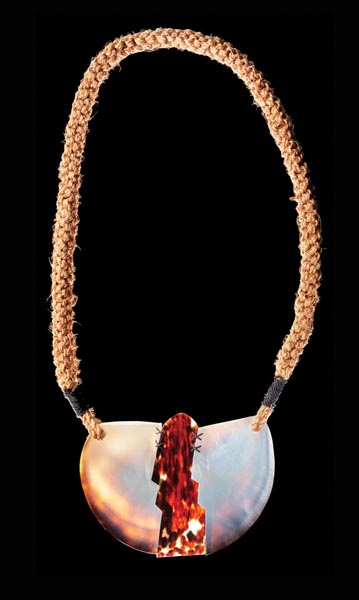
What does this mean for gimmicky jewelry? Under the electric current framework, European jewelers make gimmicky jewelry, while American jewelers make American contemporary jewelry. This points to i of the things at stake in revealing the Europeanness (the regional quality) of European jewelry discourse: it is a matter of undoing exclusion and introducing equality. Another reason to care is that, by revealing the discourse every bit regional, nosotros can disengage the pretend universality of European jewelry. The story of contemporary jewelry cannot be told by reference to Europe only, equally what happens in other places – the uneven development – is a central role of the history of the practise.
An instance: one of the reasons that Dutch jewelry from the 1960s appears universal is because it seems similar a complete and proper expression of the critique of preciousness. (New materials, a autonomous intention, the liberty to experiment.) Just it only seems consummate considering the full story of what the critique of preciousness entails is obscured.
When you bring in the strange class that the critique of preciousness took on in New Zealand, say, Dutch jewelry stops seeming universal and starts seeming like a regional expression of this investigation or theme. Information technology becomes one way of tackling information technology among many, rather than the only or most important way against which all other explorations of the critique of preciousness must exist compared.
Appetite and the Local/International Binary
The problem of the standard story of art and the binaries that information technology throws upwardly is something that fine art history is grappling with across all forms of visual fine art. The difficulty is that binaries have an awkward fashion of surviving attempts to disrupt them. It is relatively easy to swap values, so that, in our instance, American jewelry becomes dominant and European jewelry becomes the submissive partner, but doing this leaves the power structure intact. Equally Hegel noted virtually the main-slave relationship, the slave doesn't just accept to free themselves, but they have to gratuitous the master also. In other words, liberation is about disrupting the hierarchy, non simply reversing information technology. American jewelry doesn't just have to free itself, but information technology also has to liberate jewelry from the residue of the world, as well equally Europe.
If this talk were a play, all the critics would annotate on a disappointing tertiary human activity, in which the early promise of the script is unrealized. I wish at this point I could unveil some brilliant proposition that would solve the trouble, only I am just equally stumped as anyone else who thinks about these issues. I'd similar to cease this talk with what is a rather pocket-sized proposal to rethink the binary of local and international by suggesting that the two terms practice, inside ambitious jewelry, interact in a dynamic way.
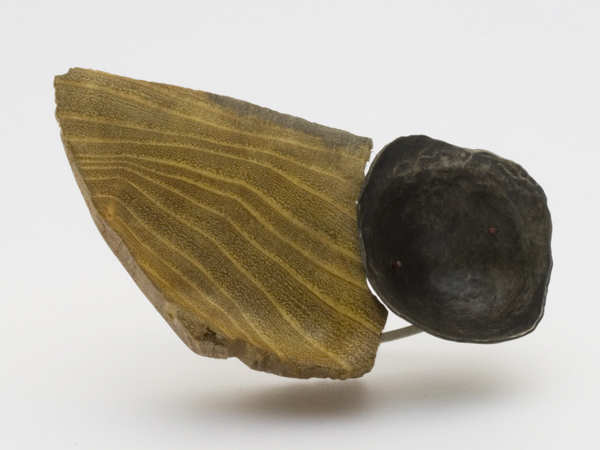
Whether operating in a state of flux or a country of fixity, ambitious jewelry works to constitute itself as function of an international jewelry discourse. Information technology is neither provincial nor parochial. It is aware of the wider world, of the larger global scene to which it belongs. What I am calling ambition is actually the ability of a jeweler to take the values of contemporary jewelry and remake them in terms of their ain cultural situation. Anybody does this – and anyone can do this, which means the field is open, and all that matters is how well yous practice it. We are very familiar with how globalized, freewheeling, de-territorialized jewelry exercise does this, merely we are less agile at reading the aforementioned dynamic in contemporary jewelry that appeals to place.
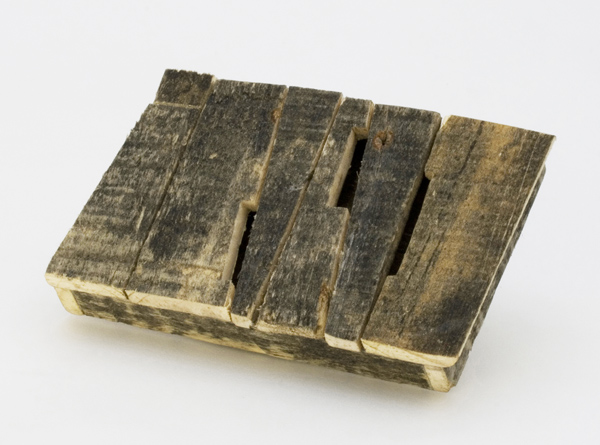
The particulars in this case are non necessary to experience the ambitions of the jewelry, which chronicle to the engagement with materiality that is one of gimmicky jewelry'south special capabilities. In an artist statement written for Schmuck 2011, the international exhibition held in Munich, Castanon defines his investigation in terms of absence, of cavities and containers that are inhabited by mute presences. As he puts information technology, 'I rescue objects and materials that were on the way to oblivion and come dorsum to communicate a minimal story.' (Castanon)
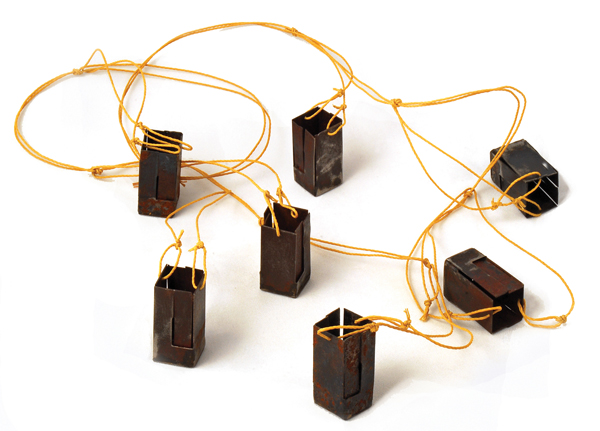
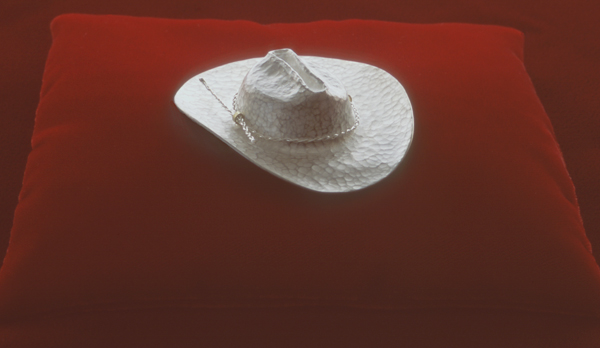

Her work emerges from the encounter of two things: contemporary jewelry, which she would define every bit a critical studio craft practice which makes objects that are grounded in an awareness of the body; and Maori systems of cognition, which place people in specific relationships to each other and to the world and which sometimes employ objects to mediate these connections. The strategies of international gimmicky jewelry are essential in this process and the fact that Wilkinson applies them to a very specific, local problem that will not be of relevance to most of the rest of the world, doesn't hateful that her practice is provincial or in any way opposed to the international.
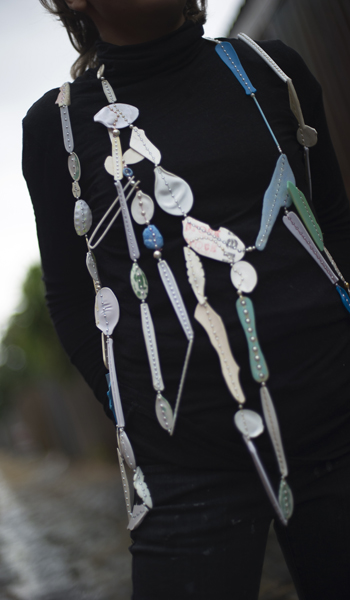
One of the virtually dynamic aspects of her piece of work is the way it traffics in questions of social relations and networks. Inside the practice of surface archaeology, this is expressed by her willingness to make outside the studio, working on park benches or picnic tables, for example, so that the process of making is available to the wider public that is using the same spaces from which her raw materials are collected. Her project Seeding the Cloud: A Walking Work in Procedure, structures the elapsing and distance of the walk by how long it takes to create a necklace from found plastic and fake pearls on a string of a pre-determined length. The necklace is made in public, using a drill and other equipment that Bartley carries in her bag.
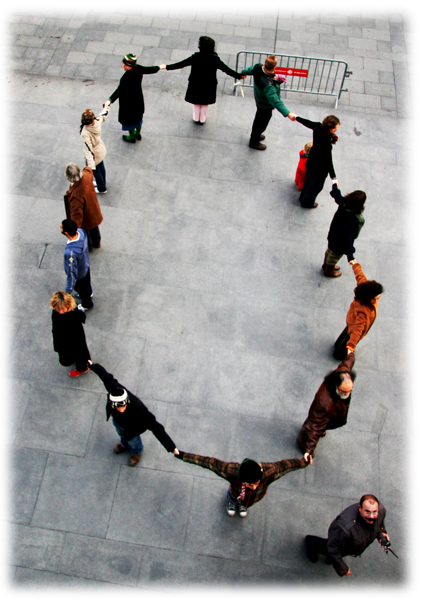
It's easy to call up of such a detailed focus on the local as being a kind of dead-end, a fast track to myopic vision and yet Bartley's practice gives serious thought to the big questions facing contemporary jewelry – specifically, its futurity as a practice in a world where the relevance of gimmicky jewelry is constantly – and rightly – questioned. In her want to engage deeply with specific places, Bartley articulates a stiff merits near contemporary jewelry's place within the relational plough that characterizes recent contemporary art and culture and suggests a way out of the ghetto that is the ultimate destination of craft's love/hate relationship with fine art. The critique of preciousness is turned outwards over again, refreshed as a tool through which contemporary jewelry can appoint with the wider world. If the international is critical for ambitious jewelry that locates itself in the local, as I hope I have shown, we shouldn't forget that the local might likewise offering something important to ambitious jewelry that chooses to de-locate itself in the international.
The Destination and the Journeying
At present I have to confess that I read Ravenhill's commodity while sitting in Air New Zealand'due south business lounge at Heathrow airdrome. I love being pampered equally part of the highly mobile global aristocracy. And notwithstanding I still want to terminate my talk by asking how this might be relevant for contemporary jewelry. So much of the contemporary jewelry scene feels like an airport business organization lounge, where the same people circulate from event to event, and the jewelry, while of very high standard, could in fact be made anywhere. I'm the starting time to admit that it's very nice in the lounge, but what are nosotros giving upwardly past sealing ourselves off in the nowhere-ness of the drome, prioritizing the journeying rather than the destination? To return to where I started, what practise nosotros gain when Künzli's Himmel brooch and its celebration of the potential of travel is placed aslope Freeman'south World Ring and its reminder that everything falls back to earth – to a specific identify – eventually.
Source: https://artjewelryforum.org/articles/all-world-over-global-ambitions-contemporary-jewelry-0/
0 Response to "What Are Your Points of Reference in the World of Contemporary Jewelry and Art"
Post a Comment